
Suicide Prevention

Suicide is the second leading cause of death for 15-34 year-olds.4
College students may be at a high risk for suicide due to the pressures of college life and the changes in environment. According to the CDC, approximately 1,100 college students die by suicide each year.
Compiled here are resources relating to suicide prevention best practices and research to aid campuses in providing effective suicide prevention.
For more information about PIP’s suicide prevention efforts, specifically Ask. Listen. Refer., please contact our staff at muwrcasklistenrefer@missouri.edu
Scope
National Data
Suicide is the second leading cause of death among 15-34 year-olds.4
For every person who dies by suicide, more than 30 others attempt suicide.1
Missouri Data
46% of Missouri college students report having suicidal thoughts at some point in their life and 21% report having suicidal thoughts in the past year.
In the past year, 1.4% of Missouri college students report attempting suicide.
61% of students who report having suicidal thoughts or who attempted suicide in the past year have not sought assistance.
33% of students also report being concerned about a friend having suicidal thoughts or behaviors.
All Missouri student data is taken from the 2025 Missouri Assessment of College Health Behaviors (MACHB) survey.
View data on suicide in Missouri from the Missouri Department of Mental Health.
82% of students have heard of the 988 Suicide & Crisis Lifeline.
Risk Factors
Risk factors are characteristics that make it more likely that individuals will consider, attempt or die by suicide. These include:
- Previous suicide attempts
- Mental illness, particularly depression, anxiety disorders, posttraumatic stress disorder, schizophrenia and certain personality disorders
- Alcohol or other substance use disorders
- Family history of mental illness or substance use disorder
- History of trauma, abuse, or sexual assault
- Family history of suicide or exposure to others that have died by suicide
- Family violence
- Chronic physical illness, including chronic pain
- Firearms in the home or access to other lethal means
- Lack of social support or social isolation
- Major life adjustment
- Incarceration
- Perfectionism
Protective Factors
The risk of suicide can be lowered by certain protective factors. They include:
- Having a strong support system (family, friends, and school)
- Spiritual beliefs or participation in a religious community
- Good self-care and positive thinking skills
- Communication, planning, and problem-solving skills
- An ability to manage strong emotions/emotional regulation
- Access to mental health care and willingness to seek and accept help
- A school environment that encourages help seeking and promotes health
- Other environmental protections, such as reducing access to firearms and other lethal means
Warning Signs
Warning signs may indicate an immediate possibility of suicide, whereas risk factors indicate someone has an increased likelihood for suicide, but indicate little or nothing about immediate danger. Warning signs include:
- Starting or increasing use of alcohol or drugs
- Aggressive, impulsive, reckless or disruptive behavior
- Talking about death and dying, expressing a strong wish to die or talking about wanting “pain” to end
- Preoccupation with death
- Planning a suicide
- Giving away belongings, tying up loose ends, saying goodbye to friends and family
- Purchasing a firearm
- Obtaining other means of killing oneself
Population Considerations
- Nearly 50% of U.S. military veteran college students reported considering suicide, and 20% reported currently having suicidal thoughts and a plan.5 An estimated 22 veterans die by suicide every day.5
- People who have experienced rape or sexual assault are 13 times more likely to attempt suicide than individuals who have not experienced sexual violence.7
- Lesbian, gay, and bisexual+ students are 3-4 times more likely to attempt suicide when compared to non-LGB+ students.8
- Young adult American Indian and Alaskan Natives have higher rates of suicide deaths than young adults of any other ethnicity.1
- Overall, the suicide death rate is higher in men, especially European American/White men. This is because this group typically chooses more lethal means. However, women attempt suicide at higher rates than men.12
Best Practices
Strategic Plan
Craft a strategic plan to address suicide prevention. Keep in mind – what specific results or changes do you hope to achieve and how will those help reduce suicide? The Suicide Prevention Resource Center has great resources and an online course for strategic planning. The Community-Led Suicide Prevention Toolkit also has information on planning efforts for suicide prevention.
Strategic Planning Process
Step 1:
Describe the Problem and Context
Step 2:
Identify Priority Problems & Long-Range Goals
Step 3:
Consult Science & Identify Strategies
Step 4:
Select or Develop Interventions
Step 5:
Develop an Evaluation Plan
Step 6:
Create an Action Plan
Step 7:
Implement, Evaluate, & Improve Intervention
The Jed Foundation’s Guide to Campus Mental Health Action Planning is also a good resource for campuses.
Thomas Joiner’s Model of Suicide Risk, 2006
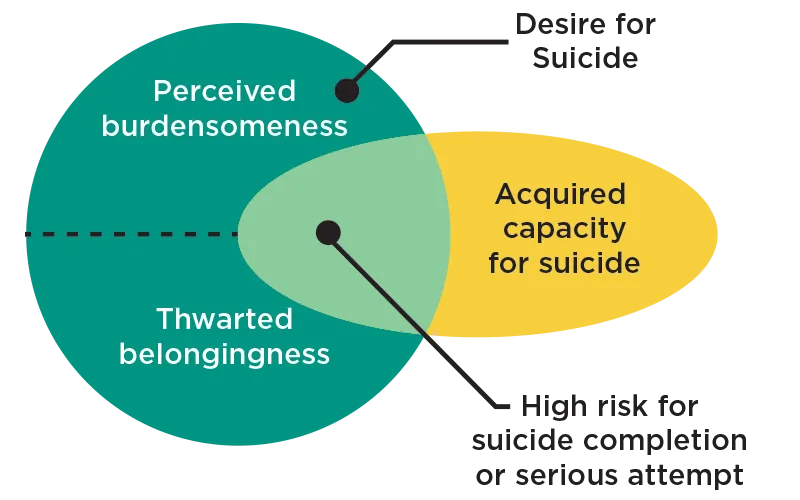
Wanting death is composed of two psychological experiences:
- A perception of being a burden to others (perceived burdensomeness). “I am worth more dead to the people that love me than I am alive.”
- By themselves, however, neither of these states is enough to move a person to act on the desire for death, but together with an acquired capacity (or fearlessness) they result in a high risk state for suicide.
- The risk is elevated where the two factors overlap – when a desire for suicide is met with the ability to carry it out.
What is acquired capacity?
- A series of painful and provocative experiences over the course of a lifetime can disinhibit a person from the fear of pain and death associated with suicide.
- Experiences may be trauma and abuse, high risk behaviors, injuries from contact sports, and a knowledge of and comfort with deadly means of suicide (e.g., firearms or lethal drugs).
- A previous suicide attempt is the strongest predictor of a future attempt.
Comprehensive Approach
- Shift the paradigm from individual to problem-centered (Drum et al, 2009).
- Empower the administrative structure of the university to become engaged with the problem of suicidality by intervening at all points along the suicidal continuum.
- Ensure that efforts span the breadth of prevention, early intervention, crisis response, treatment, and postvention
- Expanding campus dialogue around issues of suicide to include all stakeholders will help involve a greater cross-section of campus personnel.
- Create a suicide prevention taskforce.
- Address policy issues on campus such as means restriction.
Suicide Prevention Resource Center
Please visit the Resources and Programs Page from the Suicide Prevention Resource Center for more about evidence-based practices (www.sprc.org/resources-programs)
After a Suicide: A Toolkit for Schools
National Action Alliance for Suicide Prevention
Visit the National Action Alliance for Suicide Prevention for resources and information regarding their strategy and work.
Ask. Listen. Refer
- Pretest (M=21.32, SD=3.46) and posttest (M=25.95, SD=3.57) scores measuring the consumer’s cultural knowledge of risk factors, warning signs, and protective factors of suicide indicated a statistically significant improvement from pretest to posttest (t=87.404, p< 0.000)
- In 2009, when the program began, early data analysis showed that 31.2% of consumers returned to the Ask Listen Refer site after their initial login. This suggests that the online training is appealing and consumers appreciate its constant availability.
Policies
The Show Me Compassionate Medical Education Act requires:
- Each public institution of higher education to develop and implement a policy to advise students and staff on suicide prevention programs available on and off campus that includes crisis intervention access, mental health program access, multimedia application access, student communication plans, and post intervention plans.
- Said policy should advise students, faculty, and staff for identifying and addressing the needs of students exhibiting suicidal tendencies or behaviors, and require training where appropriate.
- Institutions must provide all incoming students with information about depression and suicide prevention and must be available on the website of each institution.
- The Ask. Listen. Refer Training Program was designed to help faculty, staff, and students prevent suicide by teaching participants to identify people at risk for suicide; recognize the risk factors, protective factors and warning signs of suicide; and respond to and get help for people at risk. Ask. Listen. Refer is free for colleges and universities in the state of Missouri and includes a customized site with campus and community resources. We also provide a monthly newsletter with suicide prevention resources and data on who has completed the training on your campus. To view a demo of the site or for questions, concerns, or to get started with Ask. Listen. Refer for your campus please contact us at muwrcasklistenrefer@missouri.edu or at (573) 882-2123.
Additional Competencies
The Suicide Prevention Resource Center has a great guide on creating linguistically and culturally competent suicide prevention materials.
Read the Full Guide (PDF)Interventions
Media Considerations
General Concerns and Recommendations regarding the Reporting of Suicide and Suicide Contagion
Suicide is often newsworthy, and it will probably be reported. The mission of a news organization is to report to the public information on events in the community. If a suicide is considered newsworthy, it will probably be reported. Health-care providers should realize that efforts to prevent news coverage may not be effective, and their goal should be to assist news professionals in their efforts toward responsible and accurate reporting.
“No Comment” is not a productive response to media representatives who are covering a suicide story. Refusing to speak with the media does not prevent coverage of suicide; rather, it precludes an opportunity to influence what will be contained in the report. Nevertheless, public officials should not feel obligated to provide an immediate answer to difficult questions. They should, however, be prepared to provide a reasonable timetable for giving such answers or be able to direct the media to someone who can provide the answers.
All parties should understand that a scientific basis exists for concern that news coverage of suicide may contribute to the causation of suicide. Efforts by persons trying to minimize suicide contagion are easily misinterpreted. Health officials must take the time to explain the carefully established, scientific basis for their concern about suicide contagion and how the potential for contagion can be reduced by responsible reporting.
Some characteristics of news coverage of suicide may contribute to contagion, and other characteristics may help prevent suicide. Clinicians and researchers acknowledge that it is not news coverage of suicide per se, but certain types of news coverage, that promote contagion. Persons concerned with preventing suicide contagion should be aware that certain characteristics of news coverage, rather than news coverage itself, should be avoided.
Health professionals or other public officials should not try to tell reporters what to report or how to write the news regarding suicide. If the nature and apparent mechanisms of suicide contagion are understood, the news media are more likely to present the news in a manner that minimizes the likelihood of such contagion. Instead of dictating what should be reported, public officials should explain the potential for suicide contagion, associated with certain types of reports and should suggest ways to minimize the risk for contagion.
Public officials and the news media should carefully consider what is to be said and reported regarding suicide. Reporters generally present the information that they are given. Impromptu comments about a suicide by a public official can result in harmful news coverage. Given the potential risks, public officials and the media should seek to minimize these risks by carefully considering what is to be said and reported regarding suicide.
Aspects of News Coverage That Can Promote Suicide Contagion
Presenting simplistic explanations for suicide. Suicide is never the result of a single factor or event, but rather results from a complex interaction of many factors and usually involves a history of psychosocial problems. Public officials and the media should carefully explain that the final precipitating event was not the only cause of a given suicide. Most persons who have completed suicide have had a history of problems that may not have been acknowledged during the acute aftermath of the suicide. Cataloguing the problems that could have played a causative role in a suicide is not necessary, but acknowledgement of these problems is recommended.
Engaging in repetitive, ongoing, or excessive reporting of suicide in the news. Repetitive and ongoing coverage, or prominent coverage, of a suicide tends to promote and maintain a preoccupation with suicide among at-risk persons, especially among persons 15-24 years of age. This preoccupation appears to be associated with suicide contagion. Information presented to the media should include the association between such coverage and the potential for suicide contagion. Public officials and media representatives should discuss alternative approaches for coverage of newsworthy suicide stories.
Providing sensational coverage of suicide. By its nature, news coverage of a suicidal event tends to heighten the general public’s preoccupation with suicide. This reaction is also believed to be associated with contagion and the development of suicide clusters. Public officials can help minimize sensationalism by limiting, as much as possible, morbid details in their public discussions of suicide. News media professionals should attempt to decrease the prominence of the news report and avoid the use of dramatic photographs related to the suicide (e.g., photographs of the funeral, the deceased person’s bedroom, and the site of the suicide).
Reporting “how-to” descriptions of suicide. Describing technical details about the method of suicide is undesirable. For example, reporting that a person died from carbon monoxide poisoning may not be harmful; however, providing details of the mechanisms and procedures used to complete the suicide may facilitate imitation of the suicidal behavior by other at-risk persons.
Presenting suicide as a tool for accomplishing certain ends. Suicide is usually a rare act of a troubled or depressed person. Presentation of suicide as a means of coping with personal problems (e.g., the break-up of a relationship or retaliation against parental discipline) may suggest suicide as a potential coping mechanism to at-risk persons. Although such factors often seem to trigger a suicidal act, other psychopathological problems are almost always involved. If suicide is presented as an effective means for accomplishing specific ends, it may be perceived by a potentially suicidal person as an attractive solution.
Glorifying suicide or persons who complete suicide. News coverage is less likely to contribute to suicide contagion when reports of community expressions of grief (e.g. public eulogies, flying flags at half-mast, and erecting permanent public memorials) are minimized. Such actions may contribute to suicide contagion by suggesting to susceptible persons that society is honoring the suicidal behavior of the deceased person, rather than mourning the person’s death.
Focusing on the suicide completer’s positive characteristics. Empathy for family and friends often leads to a focus on reporting the positive aspects of a suicide completer’s life. For example, friends or teachers may be quoted as saying the deceased person “was a great kid” or “had a bright future,” and they avoid mentioning the troubles and problems that the deceased person experienced. As a result, statements venerating the deceased person are often reported in the news. However, if the suicide completer’s problems are not acknowledged in the presence of these laudatory statements, suicidal behavior may appear attractive to other at-risk persons—especially those who rarely receive positive reinforcement for desirable behaviors.
988 Suicide and Crisis Lifeline
SAMHSA’s 988 Partner Toolkit
SAMHSA recognizes the need for governments, states, territories, tribes, crisis centers, and partners to speak with one voice to ensure there is a clear understanding about what 988 is and how it will work. We encourage you to use these communication outreach materials and build upon them with your community coalitions to meet the needs of your specific audiences.
Access 988's Partner ToolkitBackground
In July 2020, the Federal Communications Commission (FCC) designated 988 as the new number for the National Suicide Prevention Lifeline. By July 2022, all telecommunications companies are expected to have made the necessary changes so that 988 is accessible.1 The need for this comes from the reality that the current approach to mental health crises is simply not working.
Purpose
To connect those who are experiencing suicidal or mental health crises with appropriate and accessible services that can de-escalate mental health crises and connect individuals to the most appropriate care. The hope of the 988 system is:
- A change in community response to behavioral health crises
- A decrease in suicides and other poor mental health outcomes
- A reduction in health care spending and use of law enforcement with more cost-effective early intervention
Additionally, there is a hope that the 988 system will create a “no wrong-door integrated crisis system” that provides:
- Someone to talk to
- Someone to respond; and when needed
- Somewhere to go
Note: Given that many states are not in a place to be fully operational, the national roll-out of information related to 988 will most likely be seen in December 2022 or January 2023.
How will 988 operate in the state of Missouri?
- As of July 2022, Missouri is situated in the top 5% of states prepared for the roll out and implementation of 988
- The hope is that 988 will become “more than just a three-digit number” that will fill in gaps that the system has unknowingly created – including the hope for both follow-up and a place/person for connection after a crisis episode (i.e., wraparound services)
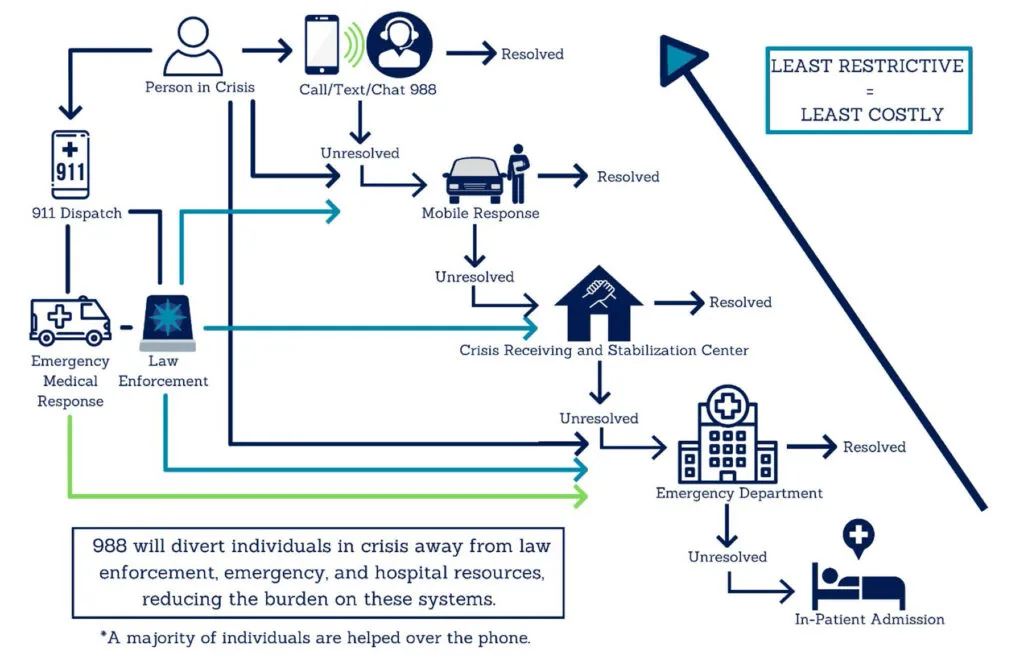
- The following flow chart can help to visualize how a person in crisis will be helped within the state3:
- 988 is active as of July 16, 2022, via call, text, or chat services at https://988lifeline.org (operated with the assistance of DeafLEAD)
- Information related to 988 must be included on all newly issued (and replaced) student identification cards at public institutions of higher education by July 1, 20234
Who will individuals be connected to when they contact 988?
Although 988 is currently NOT related to geolocation (as this will require federal legislation/regulation), the Missouri Task Force believes that there will be at least an 80% chance that someone within Missouri who contacts 988 will be connected to an individual in Missouri with a secondary call center – Provident Behavioral Health. The National Backup Network will only come into play when neither the Missouri centers nor Provident Behavioral Health are unable to answer.
988/Lifeline is a confidential service, if there is a need for a release of information due to a court order, further direction may be found through use of the Lifeline’s “Contact Us” form.
Who an individual is connected to when they contact 988 is determined through a four-step process:
How is 988 different than 911?
- 988 was established to improve access to crisis services to meet the growing suicide/mental health crisis need
- 911 is for public safety/medical emergency purposes (where the focus is on dispatching emergency medical services, fire, and police as needed)
- If a mental health crisis is at the point of being a medical emergency, continue to use 911
How is 988 different from the Crisis Text Line?
The Crisis Text Line (text HOME or MOSAFE to 741741) will still operate as a complementary service to 988 given the mental health crisis throughout the country and that “the need for mental health services is too great for any one organization to meet the demand alone.”
Additional Resources:
- Missouri Department of Mental Health
- 988 Suicide and Crisis Lifeline
- Missouri 988
- SAMHSA
- Basecamp (if you are a PIP member and need access, please contact Margo or Molly)
Citations
- CDC Suicide Facts at a Glance, 2015
- Suicidal Thoughts among College Students More Common than Expected, 2008
- National College Health Assessment Fall 2015 Reference Group Executive Summary, 2015
- AFSP Suicide Fact Sheet, 2016
- Bowen, 2011
- Thompson, 2016; Kaplan, Huguet, McFarland, & Newsom, 2007
- Kilpatrick, 2000
- LGBTQ Mental Health, 2016
- Hijioka & Wong, 2012
- Joe et al., 2006
- Suicide among racial/ethnic populations in the U.S.: Hispanics, 2013; Duarte-Velez & Bernal, 2007
- Bilsker & White, 2011
- Suicide among racial/ethnic populations in the U.S.: Blacks, 2013; Goldston et al. 2008
- Haney & O’Neil, 2012
- Salvatore et al., 2016; Russel, Turner, & Joiner, 2009
- El-Sayed, Tracy, Scarborough, and Galea, 2011
- Castle et. al (2011)
- SAMHSA, Prevention and Treatment of Anxiety, Depression, and Suicidal Thoughts and Behaviors Among College Students. (2021)
- Chen et al. (2019)
- Source: Centers for Disease Control and Prevention. (2001, May 2). Suicide contagion and the reporting of suicide: Recommendations from a national workshop. Retrieved October 20, 2004
- From: Haberyan, A. & Kibler, J. Suicide Prevention Training Manual. Northwest Missouri State University.
- AFSP/SPRC After a Suicide: A Toolkit for Schools
- HEMHA Postvention: A Guide for Response to Suicide on a College Campus
- 2022 National Survey on LGBTQ+ Mental Health
- Adams, R. E., T. G. Urosevich, S. N. Hoffman, et al. 2017. Social support, help-seeking, and mental health outcomes among veterans in non-VA facilities: results from the Veterans’ Health Study. Military Behavioral Health 5, no. 4:393–405.
- Marlow et al., Association Between Disability and Suicide-Related Outcomes Among U.S. Adults. Published August 28, 2021
- Community-Led Suicide Prevention, Integration Element. How to Use Multiple, Complementary Approaches.